Virus

The Chief Medical Officer was looking over the latest reports.

He was looking at data that had been gathered from around the country. From time to time the rules for controlling the spread of the disease were brought up to date, depending on where and how quickly the plague was spreading. He was astonished to read the findings of one of the country’s top experts who’d spent a lifetime researching contagious diseases. He was looking at the link found in the gathered data. He read through it all again before calling his assistant to his office.

When he arrived, the chief asked, “Have you seen this report?” holding it up.

“Yes. Fascinating stuff, eh?”

“I’ll say. Whoever would have believed it?”

“Well, it makes sense if you think about it.”

The chief went on. “It says here that there is a direct link between an individual’s attitude and their risk of being infected. They’ve done quite a lot of testing by the look of it and have narrowed it down to that part of the brain that determines the level of a person’s arrogance.”

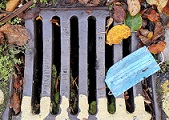
“Yes. That’s as I understand it. So, this relates directly to the issues we’re finding with people not wearing masks. According to this it’s because they feel it’s beneath their dignity. They just can’t be bothered with that sort of thing.”
The chief said, “What do you suggest?”

“Well, nothing really. I mean, this should speed the whole process up a bit, shouldn’t it?”

The chief nodded and filed the report.

Concierge

The two girls sit chatting together.

They often compare their individual lives, despite both living in the same neighbourhood.

One says, “Do you have a door attendant at your place?”

“No.”

“Thought not. We don’t have one either.”

“Why?”

“Oh! I don’t know. It would be nice, wouldn’t it?”

“Suppose so.”

“Think about it. These guys, they’re usually guys, they’re ready to open the door for you. It’s really nice. They see you coming and they open the door and stand back. If somebody wants to go in they are there, waiting. In the cities, they wear fancy coats with gold stuff on the shoulders. They’re called a concierge there. Not that I’m saying that for us. Just somebody waiting there, you know?”

Her friend said, “You always were a dreamer. That ain’t going to happen.”

“No. You’re right, but it would be nice.” Her whiskers twitch into a smile.

Pining

Teams of suited astronauts were scattered across the planet.

The project itself was not unusual. Ever since space travel beyond the Solar System became possible, these forays from Earth, out onto other planets, were carried out as part of an ongoing search for any signs of life. Several ships would land, each one sending out a group of half-a-dozen scientific researchers to scour their allotted location. These exploratory phases of a planet’s surface were slow and time-consuming, with teams working relentlessly for several months at a time. Quite often teams would spread out and overlap with others. This had been the case when he, B5, working as a biological analyst for his team, met her, C3, the chemical specialist for her team. They had worked their way along their assigned grids to be close enough to chat for short periods over a number of days. It is fair to say that many of those employed in this kind of work found it boring, to say the least. These two were no different.

They met again. After a few pleasantries, he asked, “I guess we’re all pining for home in one way or another. What do you miss most, being out here?”

She fell silent for a beat or two. With a yearning in her voice, she said, “I really miss mother nature and all its beauty; the hills and valleys, the verdant pastures, the brightly coloured flowers and the sheer variety of shrubs and trees, the amazing contrast of weather systems and the oceans, with their…”

She went on like this for some time, describing it all in great detail, when she noticed through his helmet’s visor the top half of his head was shaking slowly from side to side.

She stopped talking and said, “What? You don’t agree?” She flapped her arms out. “Tell me. What do you miss?”

She could see his eyes squint a little, as he said, “Beef, cheese and bacon pies.”

Cufflinks

Lord Harrington-Snodgrass met her while taking one of his little breaks.

He was having a Dickens of a job, finding his blue jade cufflinks. He just hoped she hadn’t been pawning stuff off again. Of course, he well knew that not everybody in the family liked the idea of him getting hitched to a short-order cook from Barcelona. He closed the drawer. That was the last place he could think of. If she were around he could ask. He moved to the window. She was probably grooming the horse again. She certainly loved that horse. He looked around the bedroom again. She was incredibly messy. She was not at all fond of cleaning. He reflected on the fact that, contrary to popular belief, she was no more amorous than any English rose. The house staff were kept busy with his new bride on board. He admired their stoicism. He absolutely needed his cufflinks, they went so well with his tie. He was speaking in the House this afternoon.

Again he gazed out of the window, this time chiding himself for his pejorative thoughts. After all, she could throw together a beef lasagne the like of which you could only find in paradise!

Sale

The man called at the address given, as arranged.

Even before he retired, he’d been doing party tricks for children for years. He knew lots of clever card tricks and he had a matchbox that could make a coin disappear. There was always blowing up balloons and making animals. The kids absolutely loved that. Anyway, he was intrigued by the tiny advert in the local paper saying that several bits of magical equipment were going for a song as the owner was trying to clear a room in his house. He rang the bell.

The owner came to the door beaming. “How’d you do, come in. It really is a case of first come, first served.” As he was lead the way to the back of the house the man kept talking. “I’ve finished with all this stuff; I have other interests now. You’ll find everything’s in perfect working order.”

He opened the door to what was probably a bedroom. He stood and pointed to the objects for sale. “In the corner there, that’s a cabinet for making people disappear. This piece of equipment here is a thought transmitting machine, and that large cubicle is a time portal.” He walked further into the room and lifting a sheet, he said, “This is a motorbike that levitates. As I said in the ad, it all has to go. That’s why I’m selling it off so cheap. I’m making room for a lodger, you see?”

The caller, although quite gobsmacked, managed to nod.

“Interested?” asked the seller.

“Well, um, yes.” He franticly took out his wallet and paid the man, saying he’d be back the next day with a truck.

He thanked him and left, knowing that his party tricks were about to move to a whole new level.

Role

She sits on a low wall, looking out across the park.

It is her habit to come here and take in the scenes that play out. She loves writing about them, describing them, bringing the various activities to life, in the form of a poem. The woman has always made time for writing poetry. She uses a large notebook to capture what she has to say. She scribbles quickly to describe things as they come about; a dog chasing a ball, children struggling up the climbing apparatus, people stopping to admire the flower beds, mothers pushing prams and strollers, family members joining in with their various ideas about where to put things on the picnic rug. All such things are being faithfully preserved in her pages.

Sometimes it can be a café, looking out through a window, or a bench on a city street. She writes about the activities as they happen. She is the recorder. Interactions between people, movements of traffic. Capturing scenes from life; setting them down in lines of poetry that reflect the way she sees them. Mostly she comes here to the park, where she sits and watches.

She sometimes wonders why she so much prefers to sit writing poems about what other people are doing, rather than doing them herself. What does it mean that she plays little part in what she sees? Is it at all strange that she prefers to record such things rather than be a part of what unfolds in front of her?

These thoughts do not linger.

This is her role.

Vagaries

The train was a long time moving off again.

He sat looking blindly at the platform’s advertisements. A woman came into view. She was running late. Did he recognise her? Surely, this was a girl from school. Now a grown woman; older, taller. He thought it was her, but he couldn’t be certain.

She was quite beautiful. Was she always that good-looking? He didn’t think so. Do people change that much in… how long would it be, ten, twelve years? Something like that. He couldn’t’ be sure.

She turned as she entered and walked towards him. She then spun around and sat down. Did she smile? Was it recognition? It was hard to tell from three rows back. Just before she turned her back to take her seat, she had looked at him for the briefest moment. He was pretty sure she did, but not completely certain. Was there a faint hint of recognition in that briefest of moments? There might have been, he couldn’t quite tell.

Metal screeched against metal as they pulled into the next station. He came out of his dream world, just long enough to see her get off and walk away down the platform. Did she raise a friendly hand as she exited? Was it an acknowledgement that she too remembered? Did it also evoke memories of their young, mostly unspoken, infatuation with one another?

He just couldn’t be sure.

Pages

From the time he was a young child he loved reading books.

So, when he was old enough, he joined the local library. He would read just about anything. Of course, as time went on he settled down into his favourites; these were mainly mystery and crime. That’s what made it so unexpectedly intriguing the day he came across the cover. It was late afternoon and the park was practically empty. The bus from school to home dropped him near the park and the footpath that ran along the far edge of it was part of his shortcut. It was on this occasion that he found the book’s cover. It was the soft cover of a paperback book. He surmised that it must have been a slim volume. Looking at the width of the spine it wouldn’t have had many pages. The picture on the front cover was interesting enough, but the title was almost obliterated with stains.

He looked around, and it was then that he noticed the pages. They had been scattered, by the wind presumably, halfway across the large, grassy field. It looked as though, despite being strewn around, they were all there. There was nowhere for them to go, being dotted around in the middle of such a wide expanse of field. So, it was with this sense of confidence that he proceeded to pick them all up. Having done this, he returned to the path and made his way to the nearest bench seat where he sat sorting them by page number. He felt sure he’d found them all when he came across the end page, but when all fifty odd pages were put in their correct sequence he realised that the first four pages were missing. Nevertheless, being an avid reader and regardless of the failing light, he sat and read it.

On continuing his journey home, he was plagued by the knowledge that quite apart from it being a really good read with a great ending, he just couldn’t imagine how it began!

Love

The tramp sat with his legs out straight, eyes closed, leaning against the wall.

He had done a lot of walking throughout the day and was both tired and hungry. It was the middle of the afternoon and this was a place he visited regularly. This was a good spot because three of the shops that backed onto the alley would often bring scraps out to the large bins around this time, after their lunchtime customers had finished. It seemed to be a tacit agreement that he could take whatever he wanted, as long as he didn’t leave a mess.

He had almost fallen asleep when he became aware of people gathering at the bus stop a short distance away at the entrance to the main road. For some reason he found himself paying particular attention to a woman and a child that were obviously engaged in a deep conversation. The woman was bending down, discussing something with the girl. Moments later, he watched as the young girl approached. He could see that she was carrying something taken from a brightly coloured, plastic lunch box. She held it out to him with a nervous smile. He took it with a nod.

It was a small, brown paper bag.

He watched her walk away, back to her mother, who looked more than a little nervous that she had permitted such a thing. He continued to watch as they all got on the bus. He felt sure that he saw a hand waving as it disappeared from view.

He looked down at what he’d been given. He realised that the child had done it out of love. He contemplated love. No matter who you are, he supposed, love can come from just about anywhere.

He opened it to find half a cheese sandwich.

Start

He walked the two blocks to school, with his parents’ row still buzzing through his head.

He left home abruptly. He’s been given no lunch today. He arrives early and takes his seat in an empty room. At his desk, he wonders, as he often does, what their home lives are like… these children around him. He has no real friends, but he thinks he should ask them anyway.

Now, late afternoon, he sits at his desk crouched over his book pretending to read down the page. His teacher has asked them all to do this. The words and the illustrations have no meaning for him. His head is still full of anger; his own, along with other peoples’. At home it never stops.

A siren sounds in the distance.

It falls silent.

At a house just a couple of blocks away, a police car sits outside his home. Inside, two officers have responded to a domestic disturbance. A man stands in handcuffs, whimpering. A bloody knife is secured in a plastic bag. A woman lies motionless.

Back in the classroom, there’s a tap on the door. He’s escorted to the headmaster’s office, where he’s told that his auntie will be collecting him today.

Some children get a better start in life than others…